
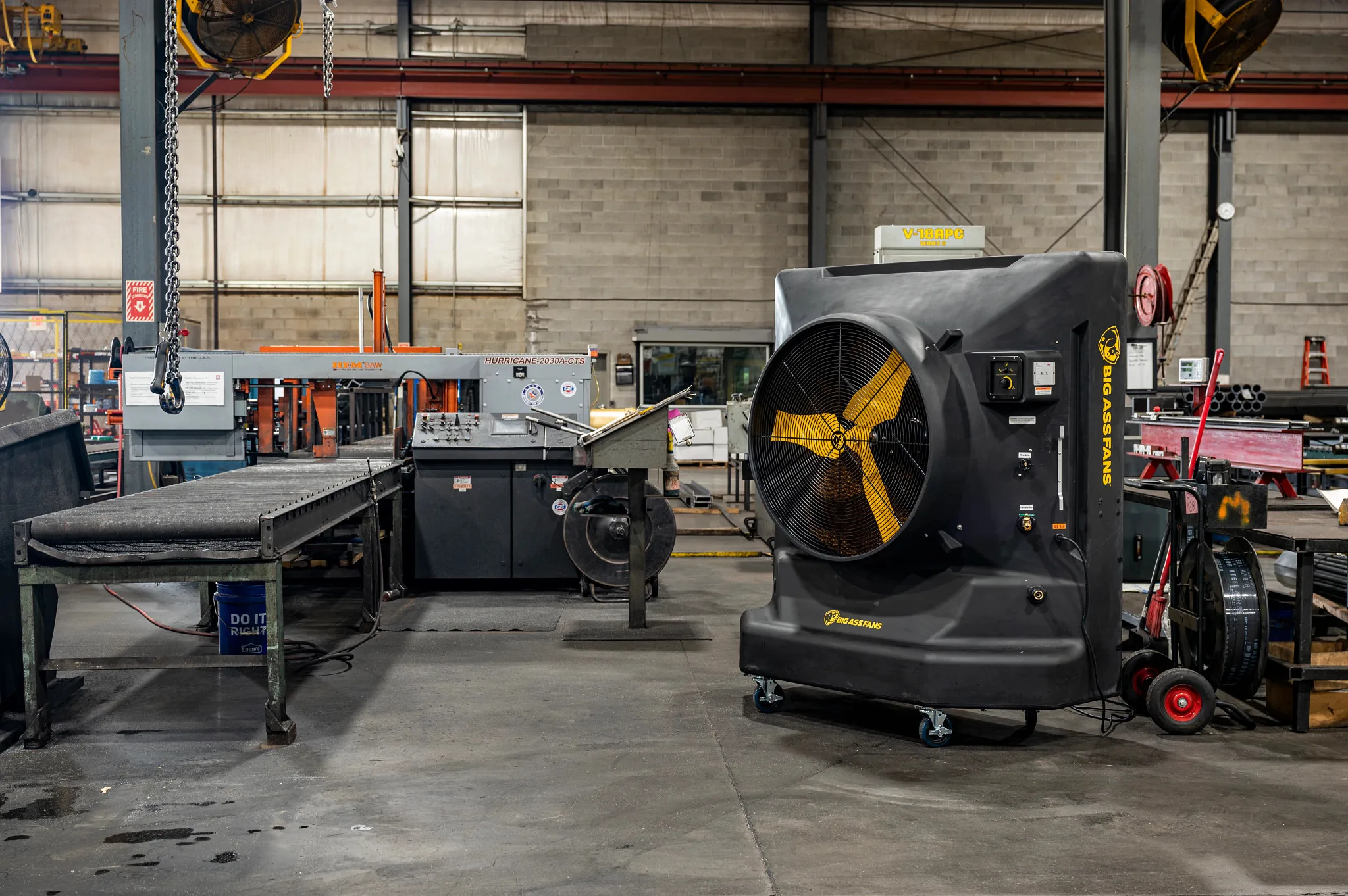
HVLS fans in the Philippines are large-diameter (2.4–7.3 m) High-Volume, Low-Speed ceiling fans that cool warehouses, factories and other large open spaces for a fraction of air-conditioning's energy. This is the complete 2026 buyer's guide — how HVLS fans work, how to size one for your ceiling and floor area, HVLS versus air-conditioning, energy savings and what drives the cost. Written by Philippine GeoGreen, the authorized Big Ass Fans supplier and distributor and an architect-led, LEED-accredited engineering team, supplying and installing HVLS fans nationwide — from Metro Manila to Cebu, Davao and beyond.
HVLS stands for High-Volume, Low-Speed. An HVLS fan is a large-diameter ceiling fan — typically 2.4 to 7.3 metres across — engineered to move an enormous column of air slowly and quietly. Instead of the harsh, localised blast of a small high-speed fan, an HVLS fan creates a gentle, floor-wide breeze that reaches people across an entire bay. That moving air speeds up evaporation on the skin, so occupants feel roughly 3–5°C cooler even though the actual temperature hasn't changed.
Because one large fan replaces dozens of small ones and runs on a single efficient motor, HVLS fans are the standard solution for cooling warehouses, factories, gyms, showrooms, churches and other large open spaces in the Philippine climate — where air-conditioning an open volume is rarely practical or affordable.
Correct sizing is the single biggest factor in getting the airflow, comfort and efficiency you're paying for. Three variables drive it: ceiling height (mounting clearance and how far air must fall), floor area and layout (open vs. partitioned, racking height), and what the space is used for (people comfort, process cooling or destratification). The indicative ranges below are a starting point — final diameter, quantity and mounting are confirmed with a free on-site assessment.
| Space type | Typical ceiling height | Indicative fan diameter | Indicative coverage per fan |
|---|---|---|---|
| Showrooms, offices, small halls | ~3.7–4.5 m | 2.4–3.7 m (8–12 ft) | up to ~230 m² |
| Warehouses, factories, gyms | ~4.5–9 m | 4.3–5.5 m (14–18 ft) | up to ~700 m² |
| High-bay logistics, large plants | 9 m and above | 6.1–7.3 m (20–24 ft) | up to ~1,000+ m² |
Indicative ranges for planning only. Coverage varies with mounting height, obstructions and target air speed; confirm against current Big Ass Fans specifications and a site assessment.
Quick rules of thumb: mount the fan so there's clear space above and below it (most large HVLS fans need roughly 4.3 m of ceiling and above); leave at least the fan's own diameter between adjacent fans; and for people-cooling, aim the layout so no work area sits in a "dead zone" between fans. For lower ceilings, compact or directional fans deliver the same comfort at reduced clearance.
The two aren't strictly rivals — but for large open spaces the economics are decisive. Air-conditioning cools air; an HVLS fan cools people by moving air. Trying to air-condition an open warehouse means paying to chill a huge volume that leaks heat through every door and roof panel. An HVLS fan delivers a comfortable, floor-wide breeze for a small fraction of that energy, and needs almost no ductwork.
| Factor | HVLS fan | Air-conditioning (open space) |
|---|---|---|
| How it cools | Moves air to cool people (evaporative effect) | Chills the air volume |
| Power draw | Up to ~1.85 kW per large fan | Tens of kW for the same floor area |
| Coverage per unit | Up to ~1,000+ m² | Limited by ducting and enclosure |
| Perceived cooling | 3–5°C cooler feel | Actual temperature drop |
| Best for | Warehouses, factories, gyms, open halls | Sealed, small or precision-climate rooms |
In large open spaces, many Philippine facilities run HVLS fans alongside AC — raising the thermostat a few degrees while comfort stays constant.
Yes — HVLS fans and air conditioning work best together. A large-diameter HVLS fan gently circulates the cooled air an AC system produces, spreading it evenly across a big space and eliminating hot and cold pockets. Because moving air feels cooler on the skin, you can raise the thermostat a few degrees and stay just as comfortable — so the AC runs less and uses less energy.
This pairing works especially well in large industrial facilities and with premium Big Ass Fans HVLS units, which move enough air to keep a whole bay comfortable at a higher thermostat setting.
Air conditioning cools the air; an HVLS fan moves it. In tall warehouses and factories, cold air sinks and stagnates near the floor while heat collects at the roof. A slow-turning HVLS fan mixes those layers (destratification), so the AC no longer fights a hot ceiling and reaches the setpoint faster and holds it with less run-time.
Yes. In the Philippine climate, the cooling effect of HVLS airflow lets facilities raise the thermostat while keeping the same comfort level, which reduces compressor run-time and cooling energy use year-round. The exact saving depends on the building, ceiling height, and how the space is used — we can estimate it for your facility on request.
It is not either/or. For a fully sealed, air-conditioned space, HVLS fans make the AC work better and cost less to run. For large, open, or partly-open spaces where full air-conditioning is impractical, HVLS fans deliver effective comfort cooling on their own. Many Philippine facilities use both, matched to each zone — see how to cool a warehouse without aircon for the no-AC approach.
HVLS fans save energy in two compounding ways. First, they let you raise or delay air-conditioning: every degree you lift the thermostat while staying comfortable cuts cooling energy. Second, in winter or in high-bay spaces they destratify — mixing the warm air trapped at the ceiling back down to floor level so heating and cooling systems work less. Layered with Solatube daylighting (which cuts daytime lighting load) and Fresh-Aire UV (which keeps HVAC coils clean and efficient), the facility's whole energy profile drops.
Actual savings depend on your facility size, operating hours and electricity rate, so we don't publish a single headline figure — we model it for your site. See our explainer on HVLS fan electricity savings, or how to cool a warehouse without air-conditioning.
An HVLS fan is a capital investment that pays back through lower energy bills and higher productivity, so the right question is total value, not just sticker price. The cost of an installed HVLS fan in the Philippines depends on four things: fan diameter and model, the number of units your floor area needs, mounting structure (some roofs need additional steel support), and installation access (working height and site conditions).
Because those variables swing the number widely, GeoGreen gives you a transparent, itemised quote after a free assessment rather than a misleading one-price-fits-all figure. As the authorized Big Ass Fans supplier and distributor we specify exactly the capacity your space needs — so you're never paying for airflow you won't use. Read our full guide to HVLS fan cost in the Philippines →
Anyone can list a fan. GeoGreen specifies, engineers and stands behind it. We're the authorized Big Ass Fans supplier and distributor in the Philippines, we're architect-led and LEED-accredited, and we hand your LEED AP or BERDE Professional the airflow data and spec sheets they can drop straight into a certification submission. That's why the country's most demanding facilities choose us.
Selected accounts. GeoGreen has delivered HVLS ventilation, daylighting and air-quality projects for many of the Philippines' leading manufacturers, developers and institutions.
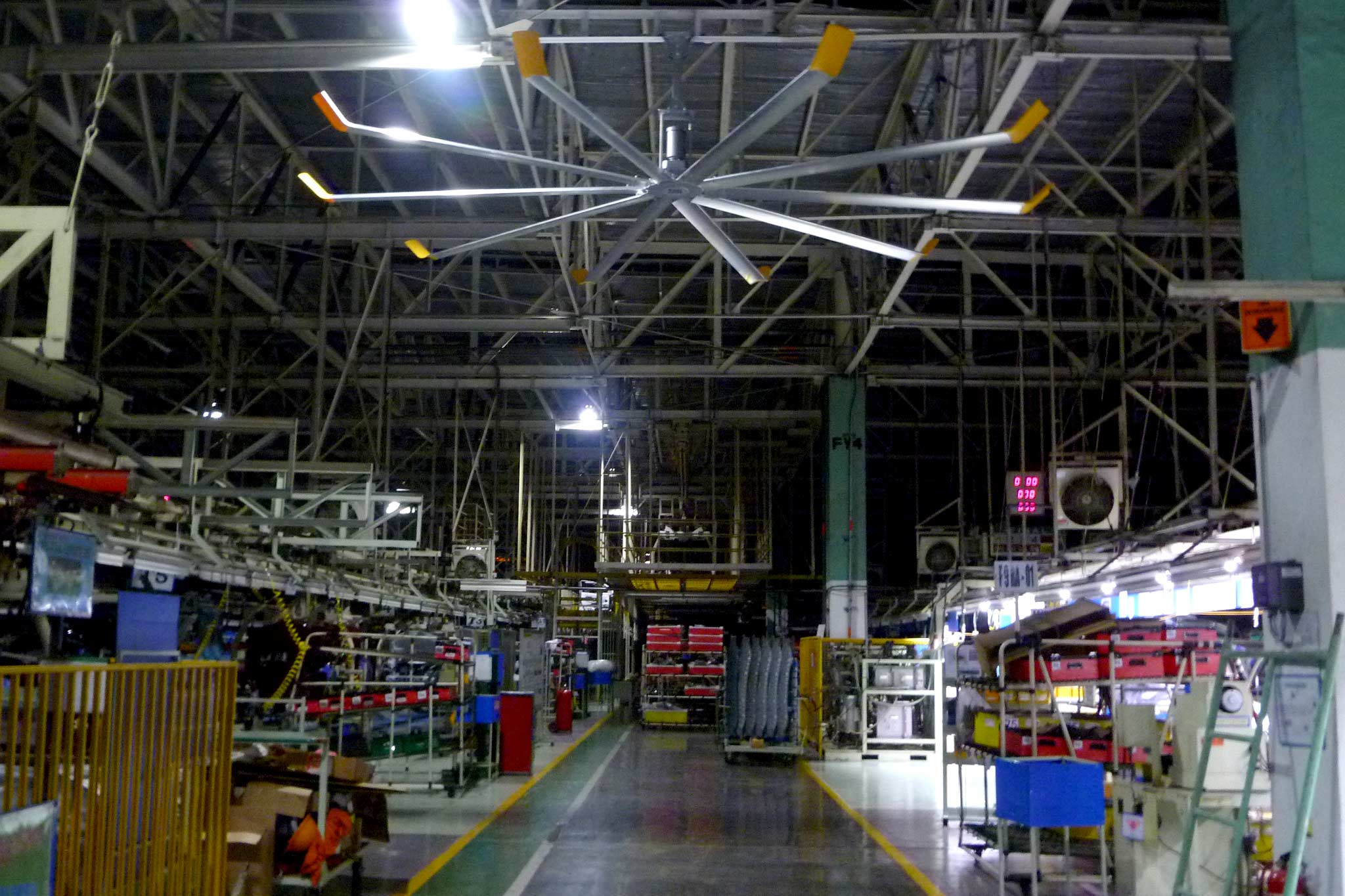 Toyota Motors PhilippinesPowerfoil X2.0 · Santa Rosa
At one of the country's most exacting automotive plants, Big Ass Fans Powerfoil HVLS units keep assembly and warehouse areas comfortable across large open bays — moving huge volumes of air on a fraction of the energy air-conditioning the same space would demand.
See industrial projects → IDS PhilippinesPowerfoil 2.0 · Pasig
In a high-throughput distribution warehouse, a large-diameter HVLS fan pushes a steady, near-silent breeze across the entire floor — cutting heat stress and humidity for staff and stored goods without the clutter and noise of dozens of pedestal fans.
Get your facility assessed →Tell us your ceiling height, floor area and goals — we'll size the fans, model your energy savings and send a transparent quote, free.